Originally published on LinkedIn on 9th October
Julian Barlow is chair of Wiltshire Wildlife Community Energy
This week a report from think tank Ember found that renewable energy sources generated more electricity than coal for the first time in the first half of 2025. That countries like China and India appear to be adopting renewables is hugely positive, but fossil fuel generation rose in the US and EU over the same period and the voices of the climate change sceptics here certainly feel to be getting louder.
The picture for renewable energy remains patchy then, but what about community energy in particular? In India, community-led renewable energy programmes are gaining traction, while China is introducing initiatives like the Photovoltaic Poverty Alleviation Program to enhance energy access in rural areas. Here in the UK, the latest State of the Sector Report (SoTS) from Community Energy England reads a bit like one of Carol Kirkwood’s weather forecasts during British summertime – a mix of bright spells, showers, and a promise of better days to come if the right conditions can align.
The report shows a sector that is moving forward, diversifying, and reinvesting more than ever into local communities, but also one that is still waiting for government policy to deliver in order to really flourish. For those of us involved with the sector in the South West, the national situation certainly feels familiar. Indeed, here in Wiltshire we’ve got big ambitions but are being held back from reaching our full potential.
I wanted to share some of the key stats from the report which I did find encouraging:
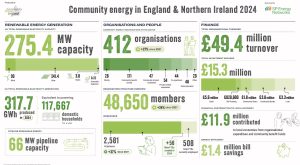
- Community energy organisations now operate 411 MW of renewable capacity, enough to power about 212,960 homes for a year.
- In 2024 alone, 22 MW of new capacity was installed, bringing the sector’s contribution to 575 GWh of clean electricity.
- The sector raised £24 million for new projects, while turnover jumped by 58%.
- Communities shared the benefits, with £3.97 million distributed through community funds.
- Households collectively saved £1.86 million on bills.
- The social impact was impressive, with 61,370 people engaging through energy advice and efficiency programmes, while 88 new full-time jobs were created.
But, as well as the positives the report also highlighted the struggle to convert promise into action. A whopping 379 MW of projects were reportedly stalled at the time of its publication, mainly due to grid bottlenecks and planning delays. Without faster progress, the report warns, the UK won’t meet its 2030 goals.
Community energy in the South West
Taking a closer look at the situation in the South West it’s clear that the national picture is reflected here – we’re determined, but we’re being hampered by the complexities of the planning system, a lack of finance, and seemingly endless technical hurdles. As far as community solar is concerned, we’re also battling to repair reputational damage inflicted by enormous commercial developers buying up swathes of land, which only serves to poison the local population against the entire notion of renewable energy.
The South West Net Zero Hub published its Community Energy in the South West report in early 2024 and, at that time, it recorded 70 community energy organisations as being active across the region but just eight operating ‘at scale’. The remainder were much smaller, often run by volunteers trying their best to navigate headache-inducing planning requirements and secure funding from a limited pot. The £1 million allocation from the Community Energy Fund for the South West was a welcome boost, but it’s simply not enough given the scale of the pipeline.
Projects worth hundreds of millions are sitting on the drawing board, but if barriers to progression aren’t lifted quickly, they face stalling in the same way as those counted in the national figures.
How to improve the outlook
The 2025 SoTS report is clear that the sector must double in size every year to hit the government’s stated 2030 ambitions. From where I’m standing, that feels like a big ask – like planting a lone tree and expecting a forest to emerge overnight. If we want to see real, measurable growth we need the provision of stable, sizeable funding. Community energy groups need to be able to hire dedicated staff and feel confident enough to tackle big projects. Clarity around Great British Energy’s Local Power Plans would also offer a greater sense of security, ensuring community projects know how we can plug in and maximise their impact.
Reforming the grid so that community groups have access to faster, cheaper, and more transparent connections will be vital, as well as better support for energy storage and local balancing. With all the will in the world, smaller enterprises will struggle to step up without the right support – mentoring programmes, knowledge sharing, and access to technical expertise will help to build capacity.
Showing local people the difference between community energy and commercial outfits is also going to be key to success, particularly here in Wiltshire. It’s so important that community is kept at the heart of it all, understanding people’s concerns and offering them an alternative to sprawling renewable sites in the form of smaller, more considered developments – providing the right project, for the right purpose, in the right place. Showing how community energy gives back also serves to boost public perception – fighting fuel poverty, cutting carbon emissions and protecting the environment as well as generating kilowatts. That’s always been our aim at WWCE.
A brighter forecast
The State of the Sector 2025 shows community energy is raising millions, saving households money, creating jobs and cutting carbon. But if the UK wants a true clean energy renaissance, community groups need the right conditions to flourish.
There is still a lot to do. Myself and the team at Wiltshire Wildlife Community Energy believe the South West can become a hub of best practice for community energy and can help drive the UK toward a greener future. With the right support from government, regulators, funders and local partners, we can sensibly scale up what works. And importantly, we can bring genuine benefit to nature, to people’s homes and to our communities.
So, while the forecast for now may be ‘partly sunny with occasional showers’, I’m hopeful that brighter skies are within reach…